

Home extension skip hire in Formby starts with the ground, because much of Formby sits on sand. It is the reason for the pinewoods and the dunes, and it is also the reason an extension here produces a different kind of waste from the same build a few miles inland. Home extension skip hire in Formby starts with the footings, and on sandy ground the footings behave in ways that surprise homeowners and even builders who normally work on clay. We have delivered skip hire in Formby for a long time, and the pattern on an extension is remarkably consistent.
Why Home Extension Skip Hire in Formby Starts With the Spoil
On clay, a footing trench holds its shape. On dry Formby sand the sides can slump as soon as the digger bucket lifts clear, and a trench planned at one width is often considerably wider by the time the building inspector is happy with it. Every extra slice of sand that falls in has to be dug out again, and all of it has to go somewhere.
That is before anyone has thought about the floor. A single storey rear extension with a concrete slab needs the garden soil stripped and the ground taken down to a firm level, and on a typical Formby plot that produces a surprising volume of pale sand with a layer of dark garden soil on top. For the first week or so of an extension, most of what leaves the site is simply ground, and ground is heavy.
Sand, Weight and Extension Skip Hire in Formby
Loose dry sand weighs something close to one and a half tonnes per cubic metre, and wet sand weighs more. What matters is what that does to a skip. An 8 tonne builders skip loaded with nothing but sand will reach its weight allowance long before it looks full, so the answer with extension skip hire in Formby is to plan the dig in loads rather than in skips. Our guide to skip size versus weight limits explains why a skip that looks half empty can already be at its safe lifting limit.
For the footings on a modest single storey extension, a 4 tonne midi skip filled with spoil and swapped as the dig goes on keeps the weight manageable and fits the narrower Formby frontages. On bigger digs, the builders skip with a measured load of sand and a top layer of lighter waste is the usual balance. What we steer everyone away from is ordering one large container, filling it to the brim with sand, and then finding out it cannot be lifted onto the lorry.
Not all of that sand has to leave. Clean sand from a footing dig is useful in the same garden for levelling under a new patio or blending into borders, and keeping some back cuts the number of skips. Where the dig leaves the garden short of growing soil once the build is finished, our top soil can be delivered to rebuild the beds around the new walls.
The Build Phase and Keeping Loads Apart
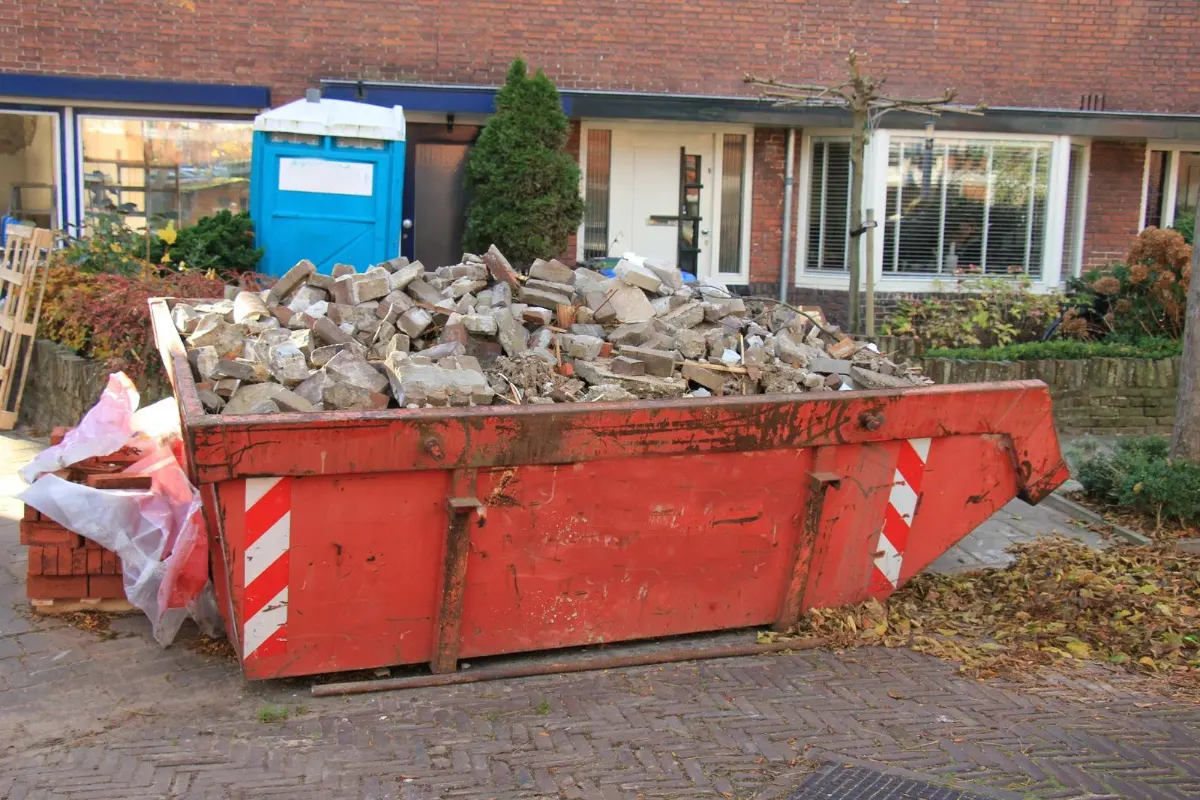
Once the footings are poured, the waste changes completely. Brick and block offcuts, broken lintels, packaging, timber from formwork and roofing, and then the knock-through into the existing house, which brings plaster, an old window or patio door and whatever was fixed to the back wall. This is mixed construction waste rather than ground, lighter per load but far more awkward in shape.
Keeping the two phases apart helps everyone. A skip of clean sand or soil is inert and easy to recover, while a mixed load needs sorting. When both go in together the whole load is treated as mixed, which is slower and costlier to process. Everything we collect comes back to our own site, and our environmental and recycling page sets out how hardcore, soil, timber and metal are separated and sent on.
The simplest way to manage it is to agree the sequence with your builder before the first skip arrives. A midi for the dig, collected and replaced as each load fills, then a builders skip from the day the walls start going up. A short conversation at the start saves paying for a large skip that sits half full of sand while the bricklayers wait for somewhere to put their offcuts.
Access, Trees and Permits for Extension Skip Hire in Formby
Formby’s leafier roads are part of its appeal and part of the planning. Around the pinewoods many drives are gravel or loose surfaced, verges are soft, and mature trees overhang the space a lorry needs to lift a skip on and off. We look at the drop point before delivery, and on soft ground we use boards to spread the weight and protect the surface underneath.
Where there is no room on the drive, which is common when the extension itself is taking over the parking space, the skip goes on the road under a permit from Sefton Council. Our guide on what Sefton Council asks before a skip permit covers lighting, placement and timing, and we handle the application as part of the booking so the skip can arrive on the day the digger does.
If the skip has to sit on the road, it needs a permit first. The GOV.UK skip permit page explains how road permits work, and we apply to Sefton Council for you.
Extensions Along the Sefton Coast
Much of this stretch of coast sits on similar sandy ground, so what we have learned from extension skip hire in Formby applies just as well to a build further along the shore. If your extension sits nearer skip hire in Ainsdale to the north or skip hire in Crosby to the south, we plan the spoil and the build waste in the same way. As a family business with more than a century behind us, we would much rather spend ten minutes on the phone getting the sequence right than send a skip that ends up too heavy to move.
When your Formby extension has a start date, call us on 01704 779345 or contact our team online. Tell us the footprint and how deep the footings are going, and we will work out how many loads the dig will produce and which skip should follow it.