
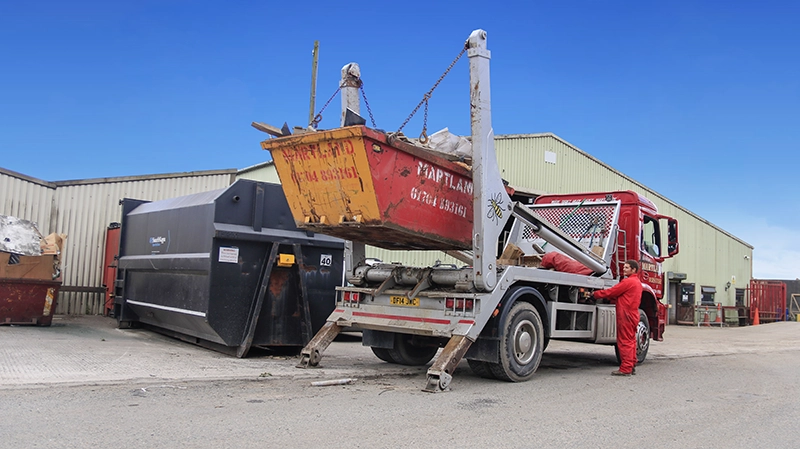
Do I really need to hire a skip is the question we field more often than any other, usually from someone standing in a garage they have not parked a car in for two years. It is a fair thing to ask, and a skip is not always the right answer. We would rather say so than take a booking nobody needed. What follows is how our team actually judges it, and where the real cut-off sits between a few trips to the tip and one of our skip sizes standing on the drive.
Do I Really Need To Hire A Skip For A Job This Size
The threshold is volume, not the sort of job it is. A hatchback with the rear seats folded flat swallows about four full bin bags of loose household waste before the boot lid stops closing, and an estate perhaps six. Once a clearance runs past a dozen of those bags, the tip run stops being one Saturday morning and quietly becomes three. That is usually the moment people stop weighing it up. A single room stripped back to the plaster, a shed emptied, a front garden dug over, or a loft that has been filling since the children left home will all pass that line comfortably.
Bulk is only half the picture. The other half is everything that will not go through a car door at all. Wardrobes, worktops, bath panels, fence panels, cast iron radiators and rolled carpet defeat most vehicles no matter how many journeys you are willing to make, and hiring a van for the day to shift them usually costs more than the container would have. When somebody rings and describes a job made mostly of awkward shapes rather than bags, our office can normally tell them within a minute which way it is going to fall.
Where The Tip Run Maths Stops Working
People costing this up in their head almost always price the fuel and forget everything else. Household waste recycling centres across Lancashire and Sefton run permit schemes for vans and trailers, so the vehicle most likely to be big enough for the load is often the one that needs paperwork before it can come through the barrier. Several sites also restrict or charge separately for what they class as non household waste, which is where rubble, soil, hardcore and plasterboard tend to land. A kitchen rip out or a patio lift can therefore run into limits that a bag of old clothes never would.
Then there is the part nobody enjoys. Weekend queues at the busier sites can eat an hour before you have unloaded anything, and you are carrying every item twice, once into the car and once out of it. Three of those round trips will take most of a weekend. A skip reverses the whole arrangement. It sits still, it opens when you do, and you carry each item once. For a job spread over a fortnight rather than a single day, which most home projects turn out to be, that difference matters more than the headline price.
Matching A Skip To The Volume You Actually Have
Oversizing costs money and undersizing costs more, because a second container always works out dearer than the right one first time. Our 4 tonne midi skip handles the large majority of domestic clearances, garden strip outs and single room refits, and it is the one we deliver most across the area. Once a project involves structural work, several rooms at once, or a full house clearance, the 8 tonne builders skip is the safer choice. If you are torn between the two, our guide to choosing the right skip size walks through it in more detail.
One thing catches people out repeatedly. A skip can reach its weight limit long before it looks full, and soil, rubble, tile and plaster are all far heavier than they appear. A midi filled with garden soil will be at its ceiling with the sides barely covered, which surprises almost everyone the first time. We have set out how this works in our piece on skip size versus weight limits, and it is worth a read before you book anything for a heavy load. Telling us what the waste is made of, rather than only how much of it there is, gets you the right container far more reliably.
What Changes When The Skip Cannot Go On The Drive
A driveway makes everything simpler, and across much of Burscough, Aughton and the newer estates that is exactly what happens. Older terraced streets and the tighter village lanes are a different matter. Where the only workable position is the highway, the placement needs a permit from the relevant authority, along with the correct lighting and markings once the light goes. We arrange this side of it as a matter of course rather than leaving you to work out who to ring, and our guide to skip hire with a permit sets out what the councils ask for.
The practical point is timing. Permits are not instant, so a roadside skip needs a few days of notice rather than a phone call the same morning. If your job has a fixed start date and no off road space, that is the single detail most likely to hold you up, and it is the first thing we ask about.
What Happens To The Load Once We Collect It
The old assumption that a skip is simply a fast route to landfill has not been true for a long time. Everything we collect comes back to our own recycling centre, where the load is sorted and the recoverable material is pulled out rather than buried. Timber, metals, hardcore, plasterboard and green waste all have their own onward routes. Running the site ourselves means we see exactly what comes off each load, which is also why we can be specific with customers about what to keep separate at their end. Our environmental and recycling page covers how the process works.
Where We See This Question Most
We take this call from every corner of the patch, though the answer shifts with the housing. Around Burscough and the surrounding villages the jobs tend to be garden and outbuilding heavy, with room to place a container off the road. Along the coast towards Southport we see more property refits and end of tenancy clearances, and rather more roadside placements on the older terraces. Both benefit from a container, but for different reasons, and both need slightly different planning.
If you are still not sure which side of the line your job sits on, ring us and describe it. Tell us roughly what is coming out, what it is made of, and whether there is space off the road, and we will tell you plainly whether a skip is worth it or whether you would be better off with the car and a free afternoon. You can reach our team on 01704 779345 or through our contact page, and we will give you a real answer rather than a booking form.