
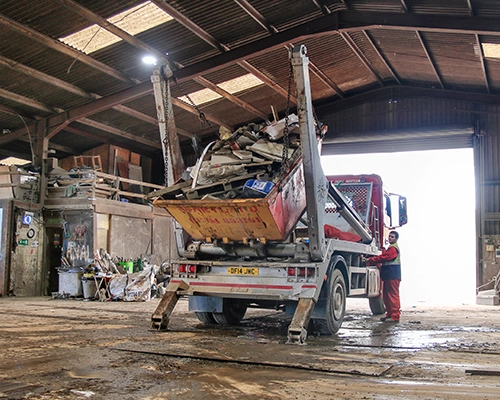
Construction generates waste faster than almost any other kind of work, and it generates the heaviest kind. From the first strip-out to the final clear-up, a site produces rubble, timber, packaging and offcuts in volumes that need a proper plan rather than a corner of the yard. Hiring a skip for construction waste is the simplest way to keep a site safe, tidy and compliant, and our service across West Lancashire is built around the realities of a working build. If you want the broader picture, our guide to builders skip hire for construction and renovation waste sits alongside this one.
Understanding construction waste streams
The first step is knowing what your site actually produces. Inert waste, brick, block, concrete and hardcore, is dense and heavy, filling a skip by weight long before it fills by volume. Mixed construction waste, timber, plasterboard, insulation and general offcuts, is lighter but takes up space. Some materials need keeping apart entirely, plasterboard being the obvious one, as it cannot be mixed with general waste under the rules. Separating streams on site is not just good practice, it makes the load cheaper to handle and far easier to recycle, and it stops you wasting capacity by piling light material on top of heavy rubble.
Choosing the right skip for the stage
Different stages of a build call for different skips. For a fit-out or a smaller job, the 4 tonne midi skip hire keeps things manageable without dominating the site. For a full build or renovation producing brick and timber together, the 8 tonne builders skip hire is the standard choice. On a larger site where waste is continuous, a roll-on roll-off skip swapped as it fills is far more efficient than repeatedly emptying smaller skips, and our roll on roll off skips guide explains when that point is reached. Getting the size right at each stage is what keeps a site from drowning in its own waste halfway through.
Weight limits and filling safely
Construction waste is where weight rules matter most. A skip filled to the brim with rubble can exceed its safe and legal load long before it looks full, and an overloaded skip cannot be lifted safely or transported lawfully. The fill line on the skip is there for a reason, and loading level with it rather than heaping above it keeps the collection legal and the road safe. If you have a lot of heavy inert material, the better approach is often a smaller skip swapped more frequently rather than one large skip you cannot safely move. We will advise on this when you book, because we would rather get it right than send a lorry that cannot lift the load.
Duty of care and your paperwork
Every business producing waste carries a legal duty of care to ensure it is handled by a registered carrier and disposed of properly, and that obligation does not end when the skip leaves the site. The waste transfer documentation we provide is your evidence that you met it, and on a commercial job it is exactly what a client, main contractor or inspector may ask to see. Our guide to the skip hire duty of care guide sets out what is expected. Keeping that paperwork in order from the start of a project is far easier than reconstructing it at the end.
Recycling and responsible disposal
Because we operate our own recycling centre, construction waste we collect across West Lancashire comes back to a site we control, where rubble, metal and timber are recovered and diverted from landfill wherever the material allows. For a contractor, that recycling record is increasingly part of winning and reporting on work, and our environmental and recycling page shows how the process works. Choosing a carrier who recovers material rather than simply burying it is a small decision that adds up across a build.
What cannot go in a construction skip
Not everything from a building site belongs in the skip, and getting this wrong can mean a rejected load or a fine. Asbestos is the big one, common in older properties across West Lancashire and strictly out of any general skip, requiring a licensed removal route instead. Plasterboard has to be kept separate rather than mixed in. Liquids, paint, solvents and adhesives, gas bottles, tyres and electrical items are all excluded too, and a tucked-away tin of something hazardous is exactly the kind of thing that causes a problem on collection day. The safest approach on any site is to set aside a clearly understood spot for anything that is not ordinary construction waste, and to ask us if you are unsure. We would far rather answer a quick question before the skip is filled than turn a lorry away because of one item that should never have gone in.
Hiring your construction skip
Whether you are running a single renovation or managing a site that produces waste every day, we will help you match the skip and the collection pattern to the work so the build keeps moving and the site stays clear from the first delivery to the final clear-up. Tell us the type of project, the waste you expect and the access on site, and we will recommend the right setup. Call our team on 01704 779345 or get in touch through our contact us page, and we will get your construction skip hire arranged.