
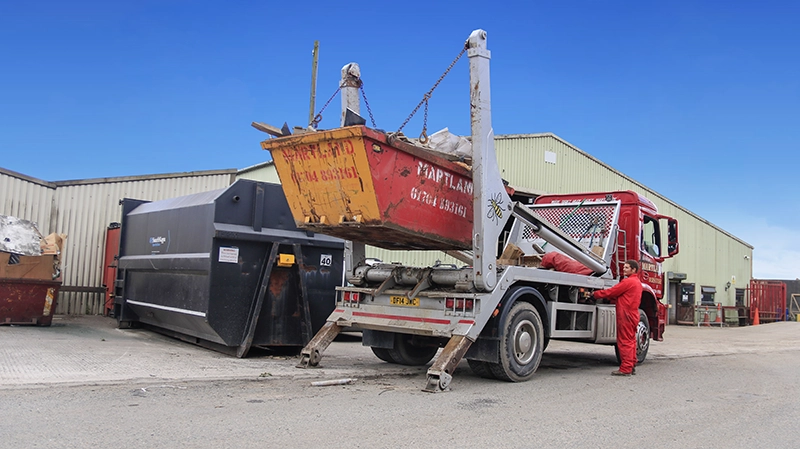
When you have waste to clear, there are two main ways to deal with it, hire a skip and load it yourself, or have a team come and take it away. Both work, but they suit different jobs, and choosing the wrong one means either paying for labour you did not need or doing more lifting than you bargained for. This is a plain comparison to help you decide, and whichever way you lean, our house clearance skip hire can handle the job.
The difference in a sentence
A skip is a container you fill at your own pace over days, dropped on your drive or the road and collected when you are done. Rubbish removal is a service where a team arrives, loads the waste for you and takes it away in one visit. The skip puts you in control of the timing and the cost but asks you to do the work. The removal service does the work but happens on its schedule rather than yours. Most of the decision comes down to which of those trade-offs suits your particular job.
When a skip is the better choice
A skip wins when waste arrives steadily over a few days rather than all at once, which describes most renovations, garden projects and gradual clearouts. If you are stripping a kitchen over a weekend or clearing a garage room by room, having the skip there to fill as you go is far more convenient than booking someone to come twice. It also tends to work out cheaper for a larger volume, because you are paying for the container and the disposal rather than for someone else’s time. For anything where the work spreads out, a skip is usually the natural fit.
When removal makes more sense
Removal comes into its own when the waste is already gathered and you would rather not lift it, or when there is nowhere to put a skip. A few heavy items, a single bulky piece of furniture, or a clearance where access rules out a skip entirely are all better suited to a team that does the loading. It also suits people who want the job done and gone in one visit rather than a container sitting on the drive for a week. If the lifting is the obstacle, paying for that labour can be money well spent.
The cost question, weighed up fairly
Cost depends on volume and effort rather than a simple headline price. For a larger clearout where you are willing to do the loading, a skip is usually the lower-cost route, because you are not paying for labour. For a small job, or one where the effort of loading is the whole problem, removal can be the better value once you factor in your own time. The trap to avoid is choosing on the sticker price alone, since the cheaper-looking option can cost more once the lifting, the trips and the timing are counted. Tell us the job and we will give you a clear steer on which works out better.
Duty of care applies either way
Whichever route you choose, the same rule sits underneath it. Your waste must be handled by a registered carrier and disposed of properly, and you should keep the paperwork as evidence, because the responsibility traces back to you even as a householder if waste is fly-tipped. Using a licensed local firm removes that risk entirely, and you receive a transfer note as proof. It is a quiet protection that a cash-in-hand clearance from an unregistered operator simply cannot offer, and it applies just as much to a removal job as to a skip.
What happens to the waste
Whether it comes from a skip or a removal job, the waste we collect comes back to our own recycling centre, where material is sorted and diverted from landfill wherever it can be recovered. That is one of the advantages of using a firm that runs its own facility, and you can read how it works on our environmental and recycling page. Choosing a carrier that recovers material rather than burying it is a small decision that adds up across every job.
Access often makes the decision for you
Sometimes the choice is settled not by cost or effort but by access. If there is truly no room for a skip, a flat with no off-road space and a road too busy for a permitted skip, then a removal team that loads from the door is the practical answer. Equally, if a skip can sit on the drive and you are happy to load at your own pace, that route is hard to beat for value. It is always worth looking at where a skip could realistically go before assuming it is not an option, because off-road space people had not considered often turns up. Describe the property and we will tell you plainly which route the access points toward.
Not sure which you need? Ask us
If you are weighing the two and cannot decide, that is exactly the kind of question we are happy to answer. Describe the waste, the access and how the job will unfold, and we will tell you which option fits and give you a clear price for it. Our advice on how to choose the right skip size helps if a skip is the answer. Call our team on 01704 779345 or use our contact us page.