
A good number of properties around here are not reached by an adopted road at all. Lanes running off the main route, shared drives serving four or five houses, cobbled setts behind older terraces and tracks up to converted farm buildings are all common, and they change the rules for skip delivery in Appley Bridge in ways that catch people out. The permit question disappears and a permission question takes its place, and the ground itself becomes the thing that decides whether the job happens. If you are booking Appley Bridge skip hire for a property like this, these are the things to establish first.
Why skip delivery in Appley Bridge needs no permit on a private road
A skip permit is a highway matter. Lancashire County Council acts as highway authority under the Highways Act 1980 and issues permits for skips standing on the adopted public road, currently at thirty six pounds per month. An unadopted road is not maintained at public expense and is not part of that system, so no permit applies and there is nothing to pay to the council.
That is the good news and it stops there. What replaces the permit is the need for the consent of whoever owns the surface, and on unadopted roads that is very often the householders themselves, each owning to the centre line of the stretch outside their own property. Where the road serves several houses, putting a skip on it without asking is a quick way to fall out with a neighbour who owns the ground it is standing on. A conversation the week before costs nothing.
Where a management company or a residents’ association looks after the lane, they are the people to ask. Some have written rules about skips, delivery vehicles and weight limits, particularly where the surface has been resurfaced recently at the residents’ own expense. Our guide to whether you need a permit to place a skip on the road in Lancashire covers the adopted road position for comparison, which is useful if part of your access is adopted and part is not.
The things our driver has to be able to do
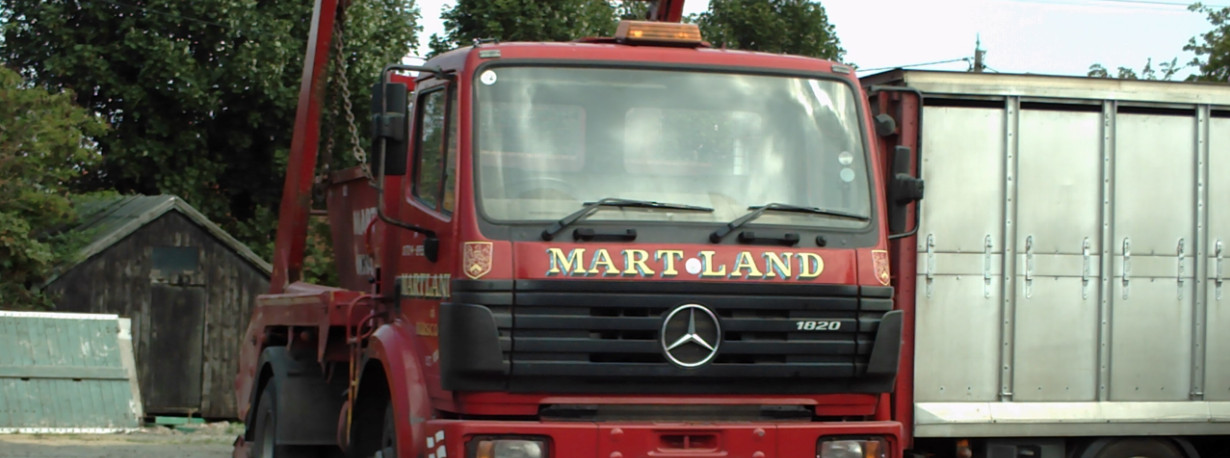
A skip lorry needs more than a car does and the difference is larger than people imagine. It needs headroom, which means overhanging branches and any low cable across the lane are a genuine obstacle rather than a scrape. It needs width at the tightest point rather than the average point, and a gatepost or a stone wall on a bend will stop a vehicle that would otherwise fit the lane comfortably. It needs somewhere to turn, because reversing a long way down a single track lane with passing places is slow and risky, and on some approaches it simply cannot be done safely.
It also needs firm ground. This is the one that decides most jobs out here. A lorry placing a skip puts a great deal of weight through a small area, and a track that carries cars all winter without trouble can still fail under a skip wagon after heavy rain. If the surface is stone, gravel or grass over a soft base, tell us when you book and we will send someone to look rather than gambling on it. A vehicle that sinks does more damage to the lane than any skip ever would.
Where the skip stands once it is there
On a shared lane, keep the skip out of the passing places and clear of any turning head. Emergency access matters here as much as neighbourly relations, and a fire appliance needs the same room our lorry does. Where there is a field gate or a farm access on the lane, do not block it even for a day, because agricultural traffic works to nobody’s convenience but its own.
If your property has any hardstanding of its own, use it. A skip on your own land removes every question about ownership, permission and liability at a stroke, and it keeps the lane clear for everyone else.
Choosing the skip when access is the limiting factor
Out here the size decision is often made by the lane rather than by the waste. Where access is tight, the 4 tonne midi skip is frequently the only realistic option, and two of those exchanged is a far better outcome than one larger skip that cannot be delivered. Where the approach is generous, which it often is at converted barns and properties with a farm track, an 8 tonne builders skip takes a serious clearance in one go. Our published skip dimensions are worth measuring against your tightest gateway before you commit.
What we do with the load
Everything we collect comes back to our own recycling centre, where it is sorted and the recoverable material is separated out rather than being passed on to a third party site. As a licensed carrier we provide the documentation with it, which matters if the waste came from a business or a let property rather than your own home.
Serving the lanes across this part of West Lancashire
Awkward access is normal rather than exceptional in this area, and our drivers have been getting skips down these lanes for a long time. We run the same service for properties arranging Parbold skip hire and for those covered by Skelmersdale skip hire, so if you are unsure whether your lane will take a lorry, the chances are we have already been down one very like it.
Describe your access to us on 01695 769123 and we will give you an honest answer about what will fit rather than sending a lorry to find out. If it is easier to show us, send us a photograph of your access and one of the team will come back to you.